


Mica retarders
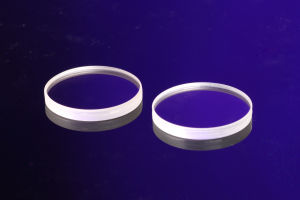

Description
The natural cleavage of mica allows accurate zero-order retarders to be made at much lower cost than in quartz. The mica is laminated between glass plates for ease of handling.
The quarter-wave plate converts linear to circular polarisation and is often used with a linear polariser to form an isolator, blocking light reflected from surfaces beyond. The half-wave plate changes the direction of linear polarisation; when combined with a polarising beamsplitter cube or prism it forms a useful variable-ratio beamsplitter. Mica retarders, being zero order, can be used over a fairly broad wavelength range; e.g. a 5% change of wavelength results in only 0.6% transmittance of light of incorrect polarisation.
|
Retardation tolderance: |
|
|
Quarter-wave |
±0.01λ |
|
Half-wave |
±0.02λ |
|
Diameter |
25mm +0, -0.2mm |
|
Thickness |
3mm ± 0.25mm |
|
AR coating |
All laminating plates are AR coated for the relevant wavelength |
• The spurious transmittance of a quarterwave plate in double passage as an isolator, or of a half-wave plate as a 90° rotator, is given by:
sin² (πΔλ/2λ)
where Δλ is the difference between the actual wavelength λ and that for which the retardance is a true half or quarter wave.
• The path-difference (retardance expressed in nm) of mica is nearly constant with wavelength, so that e.g. a quarter-wave plate for 1064nm has 266nm path-difference and is also a half-wave plate at 532nm.
• The birefringence of mica is about 0.0054, so an unlaminated quarter-wave plate for 532nm is about 25μm thick.
• Tilt of a plate can be used to tune retardance either upwards or downwards, according as the rotation is about the fast or slow axis. The effect is approximately quadratic with angle, a 10° tilt causing about 9% change in retardance.
For more information regarding stock availability icons, please see our shipping page.


