


Negative achromatic doublets
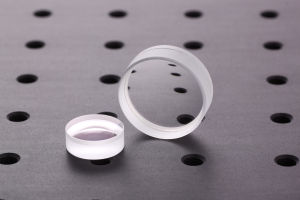

Description
These doublets easily outperform equivalent singlets even in monochromatic light, being corrected for spherical aberration and coma, as well as for chromatic aberration. Their performance and uses depend on the relative aperture. They give essentially diffraction-limited performance on axis.
Negative doublets are commonly inserted between an objective and its image to increase the tube length (as in microscopy) or magnification (as astronomy - a Barlow lens). they are therefore optimised for these conditions with a magnification of 2x. The conjuguates can of course be adjusted to vary the magnification.
|
Diameter |
+0, -0.1mm |
|
Focal length |
±0.1mm (≤10mm) |
|
Scratch-dig |
|
|
Centration |
0.1mm (FL≤40mm) |
|
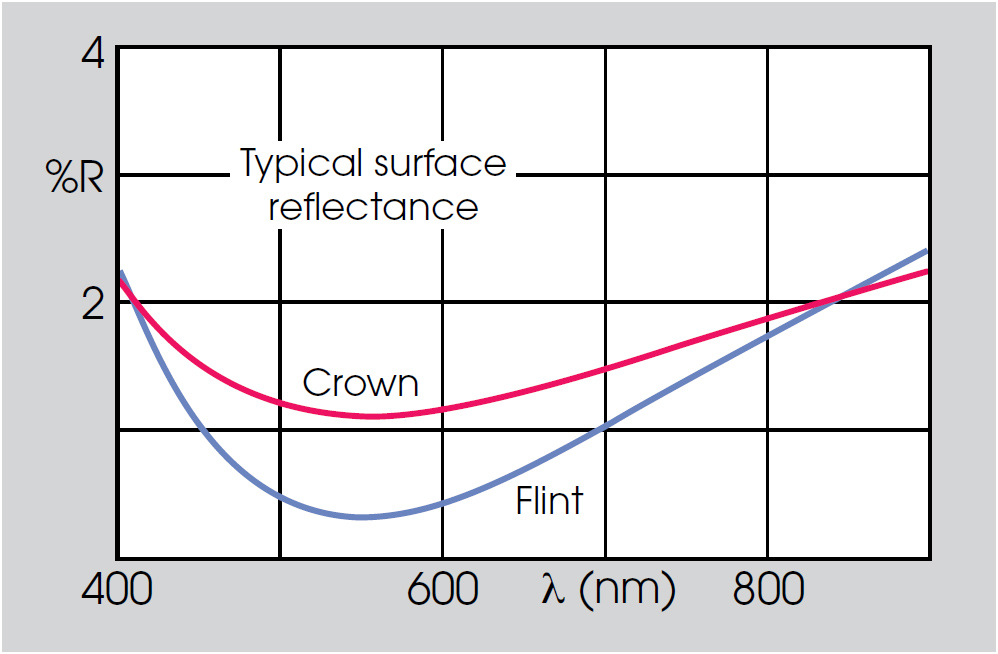
AR coating |
Full prescriptions are avaiable for computing purposes - please enquire.
| Item code | Focal length (mm) | Diameter (mm) | Back FL (mm) | Design aperture (mm) | Centre thickness (mm) | Edge thickness (mm) | Price per item (£ GBP) |
Stock available | Volume discount available |
Datasheets & customisation options |
Select amount |
|---|---|---|---|---|---|---|---|---|---|---|---|
| 63 DN 25 | 63 | 25 | 69 | 24 | 6 | 8.7 | £72.84 | ||||
| 40 DN 16 | 40 | 16 | 43.8 | 14.4 | 3.8 | 5.5 | £63.28 | ||||
| 160 DN 25 | 160 | 25 | 169.8 | 24 | 8.7 | 9.6 | £72.84 | ||||
| 100 DN 25 | 100 | 25 | 107.7 | 24 | 6.9 | 8.2 | £72.84 | ||||
For more information regarding stock availability icons, please see our shipping page.


