


Meniscus laser lenses
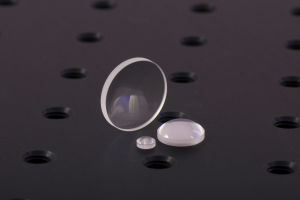


Description
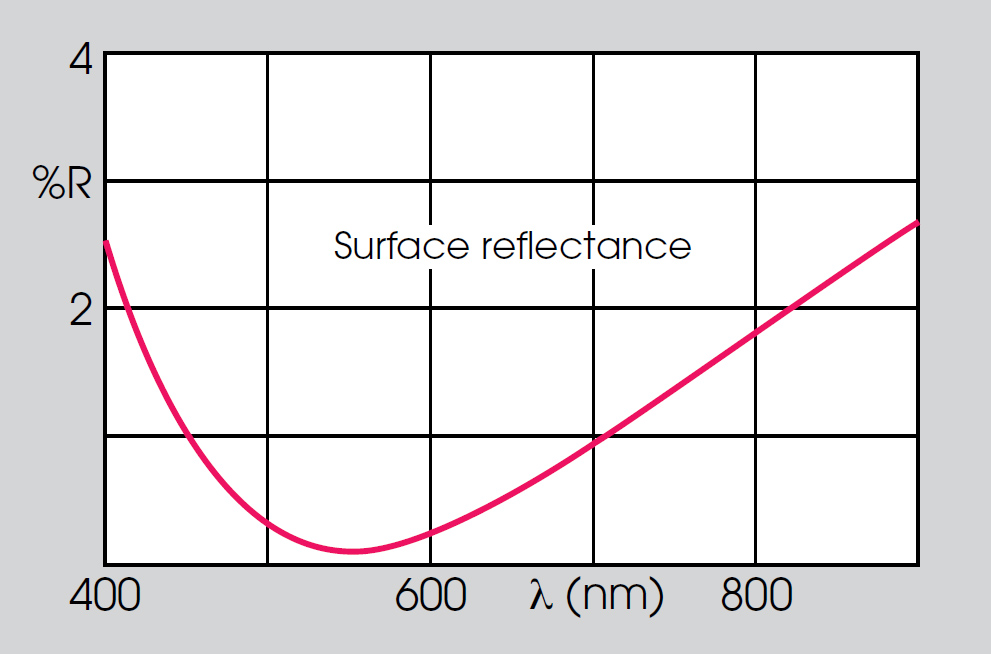
A high-index meniscus lens can be added to a focusing lens to increase its power and relative aperture with very little extra spherical aberration or coma. Those listed here are designed to be used with another lens of the same focal length (with collimated input), such as the PX series or achromatic doublets. The power and numerical aperture of the lens is then doubled. Such combinations are available on the following pages: focusing/collimating lens combinations, doublet/meniscus combinations and laser objectives. The lenses are available with and without AR coating; for coating performance see graph under the specification tab.
|
Diameter |
+0, -0.1mm |
|
Focal length |
±2% |
|
Figure (sphericity) |
λ/4 (typical) |
|
Scratch-dig |
|
|
Centration |
0.05mm (FL≤25mm) |
|
Material |
|
|
Coating (IX lenses) |
See below |
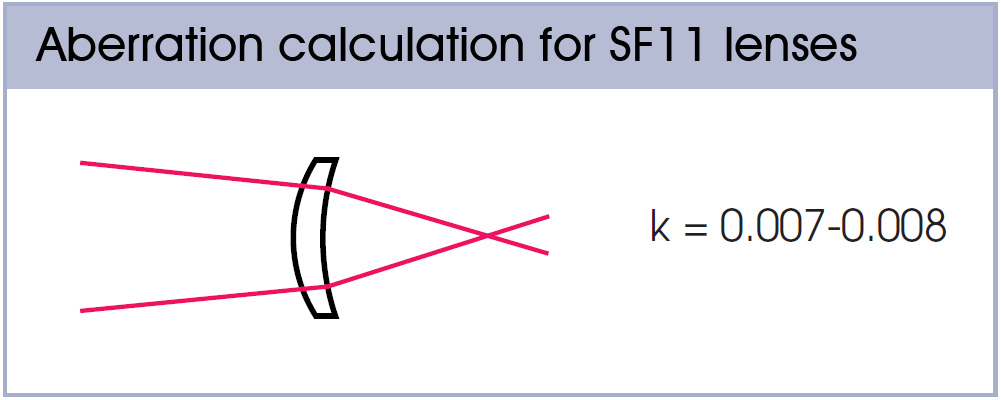
Spherical aberration calculation
To calculate the spherical aberration of a system and evaluate its effect proceed as follows.
1. Calculate element contributions
For each lens element work out the wavefront aberration A:
A = ky4/f3
where y is the semi-aperture, or maximum ray height at the element (from an on-axis object); f is the element focal length, and the coefficient k depends on material, shape and conjugates and is given in the relevant section of this catalogue.
2. Sum contributions
Simply add the contributions algebraically to give the total wavefront aberration ΣA (deviation from the best-fit sphere).
3. Evaluate effect
If ΣA is less than λ/4 the system is diffraction limited and aberration can usually be neglected. For larger aberration, the geometrical spot diameter D is given by:
D = 8 ΣAv/y
where y is as above, for the last element, and v is the distance from this element to the image.
For further detail request our Technical Note ‘Spherical aberration’.
For more information regarding stock availability icons, please see our shipping page.

