


Optical components are often coated to enhance their performance. The commonest coatings are: antireflection (AR) coatings that use optical interference between layer and surface interfaces to reduce the natural reflectivity of a glass or plastic surface; and, conversely, reflective coatings that convert a glass substrate into a mirror or partial reflector (beamsplitter). This latter is normally effected either by metal coating the substrate or by dielectric coatings that use constructive interference. Other coatings available include dichroic coatings that split between different colours or wavelengths of light, polarising coatings (normally on an interface between two prisms), narrowband coatings for transmitting just a line or narrow band of wavelengths and coatings that give other non-optical properties (e.g. scratch resistance, water/oil shedding, etc.).
You will find many of our optics are available ready coated, but if you cannot find the coating you need please ask: most components can be coated to order.
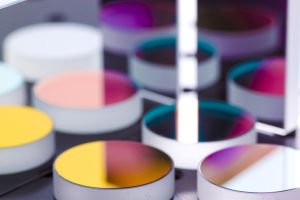

Antireflection (AR) coating improves efficiency and reduces stray light and ghost images. We list many optics ready-coated, but special coatings greatly extend the range available. The wide variety of possible substrates and coatings makes it impossible to quote standard prices; quotations are available on request. The simplest AR coating is a single layer of MgF2 (SLAR), with a minimum reflectance of about 1.3% on crown glass (see graph and box). Unlike more complex coatings, the SLAR has a reflectance at all wavelengths of less than the uncoated substrate, so it is useful for optics which may be used outside the wavelength range primarily intended. The V-AR coating is designed to minimise reflectance at one wavelength, usually specified as 0.25% max. but often in practice much better, see typical curve. A wide variety of broadband AR coatings are available; some examples are shown. Generally coatings for wider wavelength ranges have higher reflectances.
These are used on prisms for internal reflection beyond the critical angle, or in wet or dirty conditions; on flat substrates to form plane mirrors; and on lenses to form concave or convex mirrors. Protected aluminium (Al/SiOx) gives a reflectance of 85-90% (external) in the visible and is the most economical coating for small batches. Other metal coatings include Al/MgF2 for UV, gold for the IR, enhanced aluminium for higher visible reflectance and silver for internal use on prisms etc. Curves for some of these are shown http://www.comaroptics.com/images/general/products/large/Mirror%20curves%20a.jpg For very high reflectances (over 99%) and high powers, dielectric coatings are available, either for single wavelengths or broadband; these are considerably more expensive than metal coatings. However, we have an extensive stock range of dielectric mirrors (XXXXXXXX) and can often cut special sizes from stock sheet materials at short notice.
These include:
- broadband beamsplitter coatings (XXXXX), similar in cost to broadband AR coatings;
- dichroic coatings (XXXXXX) which are much more expensive, similar to dielectric mirrors;
- scratch-resistant coatings for polymer substrates
- polarising coatings;
- narrowband pass coatings;
- narrowband block coatings;
- dielectric colour-correction coatings; and
- many other possibilities exist – please enquire.

